
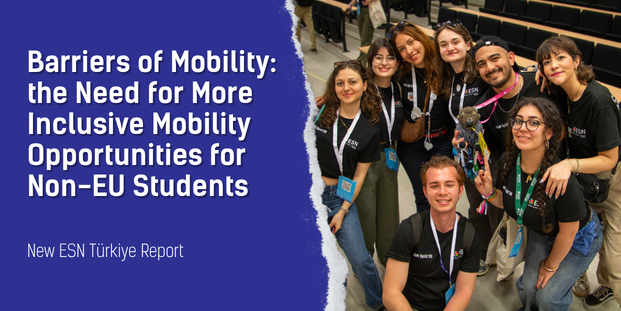
The ESN International is pleased to share the publication of "Barriers of Mobility: Visa Issues for Non-EU Students – 2026 Edition", a new report developed by ESN Türkiye that explores one of the most persistent obstacles facing international student mobility: visa and residence permit procedures.
Following the publication of the first Barriers of Mobility report in 2025, this second edition continues ESN Türkiye's efforts to document and amplify the experiences of non-EU students participating in international mobility programmes. Based on the experiences of 530 respondents, the 2026 report expands the scope of the research, providing deeper insights into the administrative, financial, and institutional barriers students encounter throughout their mobility journey. The report provides valuable insights into the administrative realities experienced by non-EU students before, during, and after their mobility journeys.
The report comes at a particularly relevant moment. In January 2026, the European Commission adopted its first-ever EU Visa Strategy, which aims to create a smarter, more modern, and more efficient visa policy while strengthening Europe's ability to attract students, researchers, and talent from around the world. According to the European Commission, the strategy seeks to make Europe more prosperous, competitive, influential, and efficient by improving mobility and modernising visa systems.
For the ESN International, these developments represent an important opportunity to strengthen the accessibility of international mobility. Erasmus+ has transformed the lives of millions of students and remains one of the European Union's most successful initiatives for promoting intercultural understanding, active citizenship, and international cooperation. As the programme continues to expand its global dimension, ensuring that students from partner countries can access these opportunities on equal terms becomes increasingly important.
The report's findings demonstrate that visa and residence permit procedures remain a significant part of the mobility experience for non-EU participants. Among the 530 respondents, 94.9% were required to obtain a visa, while 50.4% also needed a residence permit after arrival, highlighting the extent of the administrative requirements students face. The survey also found that 22.3% of respondents said visa-related concerns made them seriously consider not applying for mobility at all, while 27.6% reported that visa uncertainty had a significant impact on their financial planning, often forcing them to choose more expensive or flexible travel arrangements. Despite these challenges, students remained strongly committed to mobility opportunities, with more than 93% of respondents either currently participating in or having successfully completed their mobility programme.
This is why ESN International welcomes several priorities outlined in the new EU Visa Strategy. Among other measures, the European Commission calls for faster and simpler procedures for long-stay visas and residence permits, improved cooperation between universities and national authorities, greater digitalisation of visa processes, and enhanced support for students and researchers. These priorities closely reflect many of the challenges and recommendations identified in the report through participants' shared experiences.
The report also contributes to broader discussions on the future of Erasmus+. As Europe seeks to strengthen its global educational partnerships and attract talent from around the world, ensuring that mobility opportunities remain genuinely accessible for non-EU students will be essential. Administrative procedures should support mobility rather than become obstacles to participation.
For us, inclusion remains one of the fundamental pillars of student mobility. Regardless of nationality, background, or passport, every student should have the opportunity to benefit from the academic, cultural, and personal growth that international mobility provides. The experiences collected in this report provide valuable evidence to support policymakers, higher education institutions, National Agencies, and other stakeholders in improving existing systems and creating more student-centred mobility pathways.
ESN International believes that the objectives outlined in the EU Visa Strategy and the experiences documented in the Barriers of Mobility report provide a strong foundation for constructive dialogue and future improvements. By working together, European institutions, national authorities, universities, and student organisations can help ensure that mobility opportunities remain open, accessible, and inclusive for future generations of students.
We encourage all stakeholders in higher education and the student mobility sector to explore the report's findings and join the conversation about how Europe can continue building a mobility ecosystem that is truly inclusive for all.
Follow ESN